On the body, through the body, because of the body, in spite of the body, and at the body’s expense: Dr. Ford’s body has been the locus of violence and of public discourse about its own validity, and today her body was on trial. It was called on to be proof of itself. So many feel entitled to her body–to having her perform recitation of its encounters, justification of its whereabouts and state of sobriety. They expect her body to remember now, expect her body to have been clear enough years ago that, even if his body were not clear enough, weren’t listening, or just didn’t care, her body could have–should have–stopped his. These are all points others have discussed more articulately.
It is reductive to speak of Dr. Ford’s totality as a body, and the body is also the flesh and bone vehicle of experience, and, in that, it is everything.
We all had feelings about watching her body today, watching her body perform the act of remembering and not just remembering, recounting, and recounting so as to be believed–performing according to the parameters a public domain sets forth. She did well. I was pleased she was so articulate, and my pleasure belied that I had expectations of her. We availed ourselves of her body in this witnessing whether to lend her support or root for the laughing men in the room. Even though she was articulate, I couldn’t bear to watch today. I tuned out early. I don’t mean this was the morally better thing to do but rather to point out that, in all of our responses, her body endured machinations it shouldn’t have had to–reduction, command performance, flesh and bone sensation–and we all felt this violence, even and maybe especially those laughing goons.
Is her body pretty enough to have been raped? The pervasiveness of this logic, even in news stories supposedly in support of her, is something I haven’t seen discussed. Several newspapers, supposedly to support her, show her when she was younger and dressed to look feminine and polished. I haven’t seen many goofy or dorky images of her in high school, and I am sure there were some as there are of all of us. This curation of images by supposedly on-her-side media implicitly suggests that her prettiness makes her story believable. However, also implicit in this logic is the idea that it is believable because the rape seems more likely to have happened, and “seems” is the problem. “Oh, she was hot. I get it now.” That’s the logic. Or maybe “she was hotter than him or at least as hot as him.” One must do the math. One must calculate Her Body vs. His Body. Yet, if she were pretty enough (whatever that means) then it becomes somehow understandable and there is only a short slip to acceptable from there. This discourse has played out on her body, at her expense and at ours.
I have found some antidote in these writers’ compassion and fierce acumen:
“Carelessness does not make sexual assault an expected outcome…” From “The Times I wasn’t Raped” by Zoe Zolbrod.
“No one really believes this woman is lying. If they vote him in: It is because they believe her and don’t care. We should stop saying believe. It’s not about that anymore. It is about whether or not they care.” From Twitter thread by author Glennon Doyle on today’s “trial”
“They Don’t Want to know: Rebecca Solnit on Brett Kavanaugh and the Denial of Old White Men”
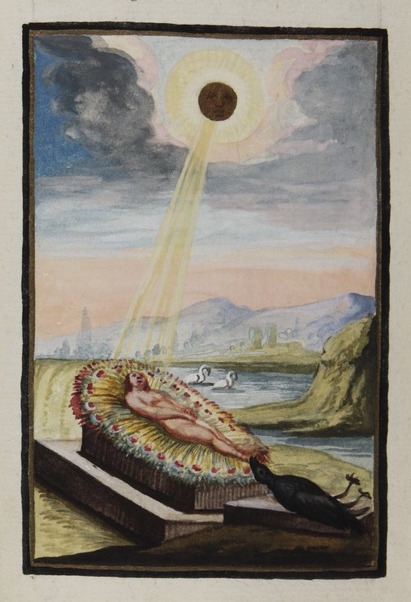
Image credit: From Compendiolum de praeparatione auri potabilis veri, attributed to M[arcus] E[ugenius] Bonacina, ca. 1790 accessed via Public Domain Review's collection, The Surreal Art of Alchemical Diagrams.
.
 Close to the Surface